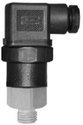
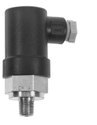
About P56N Low Pressure Diaphragm Pressure Switch
P56N equips with a spring-supported diaphragm(or piston), the changing pressure pushes diagram(or piston) travelling, which will trigger
the mechanic devices to send out switching signal as calibrated pressure is reached.
Output: NO / NC programmable
Compact design
DIN plug
Versatile and Durable ConstructionWith a sturdy die-cast aluminum housing, the P56N Pressure Switch offers exceptional resistance to mechanical impact and environmental factors. Its powder-coated finish and IP65 protection ensure optimal performance even in harsh industrial settings, providing dependable use across a broad temperature range of -20C to +80C.
Flexible Configuration for Various NeedsThe P56N can be set for either adjustable or fixed switching differentials, allowing users to tailor the device to specific application requirements. The compact design enhances placement versatility, and both panel and direct mounting options are supported for integration into new or existing systems.
Reliable Operation and Low MaintenanceBuilt to last, the P56N boasts a mechanical life of over 1,000,000 operations. Thanks to its high-quality silver-plated contacts and robust insulation, the switch remains dependable under repetitive use, making it a cost-effective choice for continuous monitoring in automation and process control applications.
FAQs of P56N Low Pressure Diaphragm Pressure Switch:
Q: How does the P56N Low Pressure Diaphragm Pressure Switch operate?
A: The P56N utilizes a diaphragm mechanism to detect changes in air or non-corrosive gas pressure. When the pressure reaches the preset set point (between 20 and 300 mbar, depending on the model), the switch actuates, changing the state of its SPDT contacts to activate or deactivate connected equipment.
Q: What are the key benefits of using the P56N pressure switch in automation systems?
A: The P56N offers high reliability, fast response time (<10 ms), and a long mechanical life (>1,000,000 operations). Its robust build and IP65 protection allow it to withstand challenging environments, making it a dependable solution for monitoring and controlling low-pressure air and gas processes.
Q: When should I choose a model with an adjustable switching differential?
A: An adjustable switching differential is useful when your application requires fine-tuning the difference between the activation and deactivation pressures. This feature is especially helpful in systems where precise control over process hysteresis is vital for operational efficiency.
Q: Where can the P56N Pressure Switch be installed?
A: This pressure switch is designed for flexibility and can be mounted directly onto a system or onto a panel using standard screw mounting. Its compact dimensions (approx. 110mm x 36mm x 36mm) make it suitable for installations where space is limited.
Q: What is the process for setting the pressure switchs set point?
A: To set the desired actuation point, use the adjustment mechanism provided on the device (for adjustable models). Precisely adjust the set point within the 20-300 mbar range as required for your application, following the manufacturers instructions to ensure proper calibration and operation.
Q: What types of media are recommended for the P56N switch?
A: The P56N is specifically designed for use with clean air and non-corrosive gases. Using unsuitable or corrosive media can damage the diaphragm and compromise the integrity of the pressure switch.
Q: How does the P56N ensure electrical safety and long-term reliability?
A: The switch includes silver-plated contacts for minimal resistance, high insulation resistance (>100M at 500V DC), and durable screw terminals for secure electrical connections. These features collectively contribute to safe operation and sustained performance, essential in industrial environments.






 Send Inquiry


 Send Inquiry

 English
 Spanish
 French
 German
 Italian
 Chinese (Simplified)
 Japanese
 Korean
 Arabic
 Portuguese